
How the Post-COVID Workplace Redefined Overhead
Published July 7 2025
When COVID-19 emptied offices in early 2020, “work” stopped being a place and became an activity. Five years on, remote-first operations and borderless hiring are no longer stop-gaps—they’re line‑items on the balance sheet that executives use to drive profitability. Let’s unpack the numbers (graphs included) and show exactly how much money businesses have clawed back—and why the biggest savings may still lie ahead.
1. The Remote Work Revolution in Numbers
After the 2020 spike, exclusive remote work has stabilised near one‑quarter of the U.S. workforce, while hybrid roles dominate.
Key milestones:
- 33 % fully remote in 2020 as lockdowns hit.
- 25–26 % through 2023, indicating a durable preference even as offices reopened.
- ~30 % of workdays will be remote in 2024—hybrid remains the majority model.
- 26 % in early 2025, confirming a new baseline rather than a fad.
*Remote-capable workforce; figures vary by methodology, but trend lines align across Gallup, WFH Research, and Reuters.
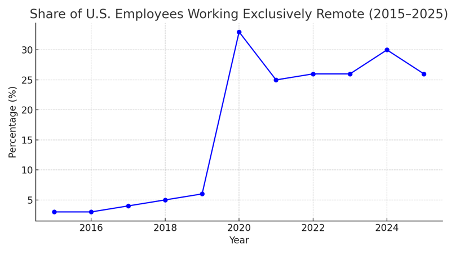
Graph 1 illustrates the dramatic shift in remote work adoption: from low single-digit figures between 2015–2019, to a sharp spike in 2020, followed by a stabilised plateau where roughly one-quarter of the workforce remains fully remote, even as hybrid models became the dominant norm.
2. What Those Percentages Mean for Your P&L
Hard savings per remote employee
- $11 000+ per year in real estate, utilities, absenteeism and turnover for half-time remote schedules
- Employee‑side bonus: skipping the commute, clothes, and lunches is worth up to $12 000 annually
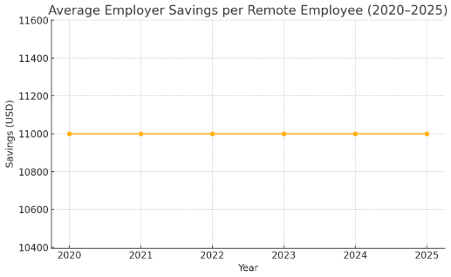
Graph 2 shows the recurring $11 000 baseline that finance teams now bake into cost-benefit models.
Multiply $11 000 by even a modest 100 remote-capable roles and you’re staring at $1.1 million in annual margin expansion—before tax.
Hard Savings You Can Book
Global Workplace Analytics finds the average U.S. employer saves $11 000 per remote employee each year—and that figure has held steady since 2020.
Where those savings materialise:
| Cost Bucket | Typical Cut | Drivers |
| Real‑estate & utilities | 30‑60 % | Smaller footprint, lower energy, janitorial, security |
| Absenteeism & turnover | 10‑25 % | Flexibility boosts engagement; hybrid reduces quit rates |
| Facilities services | 100 % (for fully remote) | Parking subsidies, coffee, office supplies eliminated |
| Carbon footprint | 54 m t CO₂ off the road annually if half of eligible staff work remotely half‑time | globalworkplaceanalytics.com |
Multiply the $11 000 benchmark by 200 remote‑eligible roles, and you unlock $2.2 million in annual margin, before tax.
3. Going Borderless: Global Hiring as a Force‑Multiplier
Remote infrastructure also removes geographical hiring constraints. By tapping talent in lower-cost regions, you unlock labour‑cost arbitrage that traditional offshoring once promised—but now with real-time collaboration tools and Employer‑of‑Record (EoR) platforms:
- Up to 70 % labor‑cost reduction when tasks are outsourced to countries like the Philippines or LATAM hubs.
- Flexible EoR partners handle tax, compliance and payroll, cutting red‑tape costs hbr.org
Example scenario
| Role | U.S. median salary | LATAM equivalent | Annual saving |
| Front‑end developer | $110 000 | $45 000 | $65 000 |
| CX specialist | $55 000 | $20 000 | $35 000 |
| Virtual assistant | $48 000 | $15 000 | $33 000 |
Employer‑of‑Record (EoR) platforms (Deel, Remote, Multiplier) shoulder compliance and payroll, turning what used to be a 6-month entity‑setup slog into a two-week onboarding flow.
4. Secondary Benefits That Don’t Fit on a Ledger (Yet)
- Talent reach: access 24-hour coverage and rare skill sets otherwise unavailable locally.
- Diversity gains: broader hiring pools improve creativity and market insight.
- Sustainability: fewer commutes = lower carbon footprint; 54 million tons of CO₂ shaved off if half of the eligible U.S. staff work from home half the time.
- Disaster resilience: distributed teams keep operating during local outages or extreme weather.
5. Implementation Blueprint for HR and Finance Leaders
- Audit remote-capable roles – Use a task-based analysis; don’t rely on job titles.
- Calculate the true total cost of office occupancy – Include depreciation and soft costs.
- Pilot hybrid first – Aim for 2–3 anchor days if culture or client work demands facetime.
- Invest in async tooling – Git‑style documentation, video stand-ups, and self-serve knowledge bases bridge time‑zone gaps.
- Layer in global hiring – Start with non-critical time‑zone-friendly functions (e.g., design, QA) before expanding to revenue-critical roles.
- Measure & iterate – Track employee Net Promoter Score, retention and cost per deliverable, not hours‑in‑seat.
Key Takeaways
- Remote work has stabilised—not disappeared—at a level that delivers predictable, recurring savings.
- $11 000 per remote employee per year is now a conservative benchmark; employees themselves are pocketing similar amounts.
- Global hiring can multiply savings up to 70 % on labour while widening talent funnels.
- Companies that combine hybrid flexibility with cross-border recruiting are building leaner, more resilient cost structures for the next downturn or pandemic.
That’s why GuildSteam is dedicated to helping small businesses unlock the power of offshore talent. As your trusted global hiring partner, we source highly skilled remote professionals—precisely matched to your business needs. Whether you need virtual assistants or back-office support, we help you streamline operations and cut admin costs by up to 70%, all without sacrificing quality or reliability.
- Global compliance & payroll: We ensure you’re always compliant with local tax laws, employment regulations, and contracts—whether you’re hiring in Philippines, Mexico and South Africa.
- Sourcing vetted remote talent: From creative specialists to customer support to admin assists, our global pipeline is curated for quality and speed.
- Localised onboarding support: We help your new hires feel like part of the team from day one, with equipment procurement, orientation, and culture coaching.
- IP & security protections: All GuildSteam contracts include strong non‑disclosure and IP assignment clauses, giving you peace of mind across borders.
Whether you’re building a distributed support team or tapping into global development hubs, GuildSteam simplifies hiring, ensures compliance, and helps you unlock the full value of a global workforce—efficiently and responsibly.
To learn more, visit guildsteam.com or schedule a strategy consultation with one of our global hiring experts.
FAQs
Q1. How accurate is the $11 000 figure—is it U.S.‑only?
A: The Global Workplace Analytics model is U.S.-centric but covers universal line items (real estate, utilities, absenteeism). Adjust for your country’s property and wage norms for best results. globalworkplaceanalytics.com
Q2. Won’t productivity drop if everyone is remote?
A: Large-scale studies show productivity holds steady or rises when remote work is voluntary and supported by the right tools; issues surface mainly when policies are unclear. reuters.com
Q3. What about hybrid vs. fully remote—where’s the sweet spot?
A: Gallup finds 55 % of remote-capable employees prefer hybrid; hybrid also maximises engagement benefits while minimising isolation. gallup.com
Q4. How do we protect IP when hiring abroad?
A: Use reputable EoR providers, enforce strict NDAs, and segment access rights. Most EoRs bundle IP protection clauses into their service agreements. hbr.org
Q5. Is the 70 % labor‑cost saving realistic for skilled roles?
A: Yes—especially in support, CX, and certain engineering disciplines. Savings decline as roles become highly specialised or demand niche experience, but 40‑50 % reductions are still common.
Sources
- Global Workplace Analytics, Telework Savings Potential, 2025. globalworkplaceanalytics.com
- Reuters Breakingviews, “Hey Team: Weaker hiring means back to the office,” Oct 9 2024. reuters.com
- WFH Research, How Much WFH in the United States?, Jan 2024. wfhresearch.com
- Velocity Global, 62 Remote Work Statistics for 2024, Sept 2024. velocityglobal.com
- MicroSourcing, How much can your business save by outsourcing?, Feb 2025. microsourcing.com